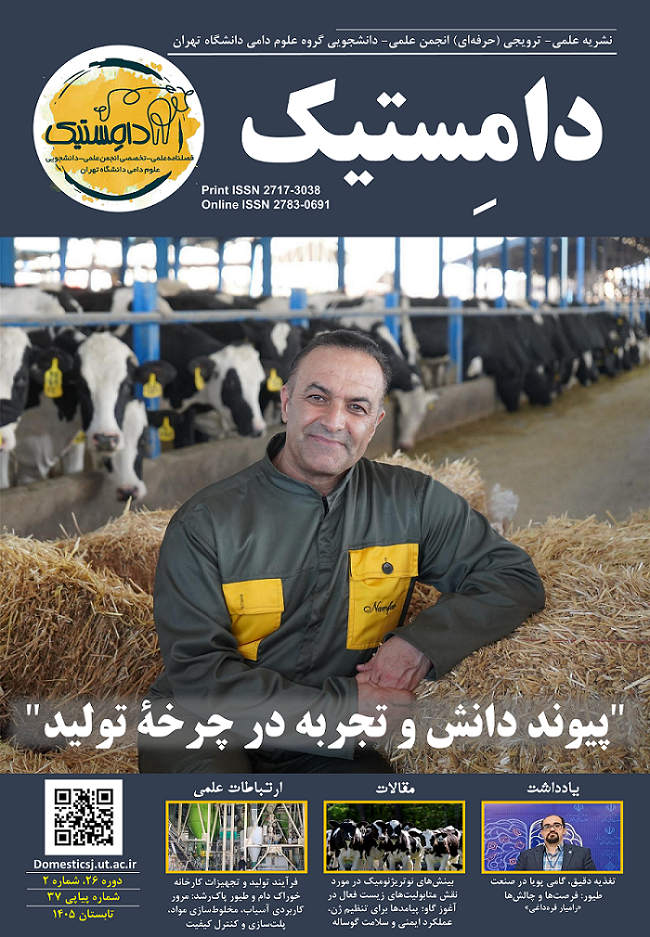
علمی- ترویجی (حرفه‌ای) دامِستیک

علمی- ترویجی (حرفه‌ای) دامِستیک

چالش‌های شرایط جنگی و پساجنگ در تغذیه طیور؛ تجربیات گذشته جهانی و تاب‌آوری صنعت

نوع مقاله : مقاله علمی- ترویجی

نویسندگان
1 دانشجوی دکتری تخصصی تغذیه طیور، گروه مهندسی علوم دامی، دانشکده کشاورزی، دانشگاه فردوسی مشهد، مشهد، ایران
2 دکتری تخصصی تغذیه طیور گروه مهندسی علوم دامی، دانشکده کشاورزی، دانشگاه ارومیه، ارومیه، آذربایجان غربی، ایران
3 دانشیار تغذیه طیور، گروه مهندسی علوم دامی، دانشکده کشاورزی، دانشگاه ارومیه، ارومیه، آذربایجان غربی، ایران
10.22059/domesticsj.2026.422501.1258
چکیده
چالش‌های مختلفی در زمان بحران‌های جنگ و پساجنگ صنعت پرورش طیور را تهدید می‌کند. صنعت پرورش طیور در طول تاریخ، با وقوع جنگ‌ها و دوران پساجنگ همواره با تهدیدات جدی مواجه بوده است و این موضوع دولت‌ها و متخصصان طیور را بر آن داشته است تا برای عبور از بحران‌های ناشی از آن تلاش نمایند. اوج این بحران‌های جهانی در زمان جنگ جهانی دوم در قاره اروپا بروز و ظهور یافت و سبب تضعیف این صنعت شد و زنجیره تأمین غلات و مواد اولیه خوراک عملاً دچار چالشی جدی گردید. احتمال آسیب و اختلال در واردات نهاده‌های دامی در زمان‌های بحرانی نیازمند تمهیداتی علمی و کاربردی است. به دنبال این اختلالات و افزایش قیمت مواد اولیه خوراک، تولیدکنندگان ناچار به بهره‌گیری از رویکردهای نوین در تغذیه هستند تا با مدیریتی هوشمندانه و به کارگیری جایگزین‌های خوراکی، ضمن کاهش وابستگی به نهاده‌های متداول، تعادلی میان هزینه‌های جاری و بهره‌وری اقتصادی ایجاد نمایند.
کلیدواژه‌ها

عنوان مقاله English

Challenges of War and Post-War Conditions in Poultry Nutrition, Past Global Experiences and Industry Resilience

نویسندگان English

Ramyar Gharedaghi 1
Amir Mosayyeb Zadeh 2
Seyed Ali Mirghelenj 3
1 Ph.D. Candidate of Poultry Nutrition, Faculty of Agriculture, Ferdowsi University of Mashhad, Mashhad, Iran
2 Ph.D. in Poultry Nutrition, Department of Animal Science, Faculty of Agriculture, Urmia University, Urmia, West Azerbaijan, Iran
3 Associate Professor of Poultry Nutrition, Department of Animal Science, Faculty of Agriculture, Urmia University, Urmia, West Azerbaijan, Iran
چکیده English

Various challenges threaten the poultry production industry during periods of war and post-war crises. Throughout history, the poultry industry has consistently faced serious threats with the onset of wars and post-war periods, prompting governments and poultry specialists to strive to overcome the resulting crises. The peak of these global crises emerged during World War II in Europe, which weakened the industry and caused the supply chain of grains and feed raw materials to face a serious challenge. The possibility of damage to, and disruption in, the import of animal feed inputs during critical periods requires scientific measures. Following these disruptions and the increase in feed ingredient prices, producers are forced to adopt modern nutritional approaches so that, through smart management and the use of feed alternatives, they can reduce dependence on conventional inputs while creating a balance between current costs and economic productivity.

کلیدواژه‌ها English

Challenges
Post-war
Poultry nutrition
Resilience
War
Antonyuk, P. O., & Kramskyi, S. O. (2023). “Institutional mechanisms for ensuring the sustainability of the functioning of the Ukrainian market of poultry meat and eggs in the aspects of food security in the post-war period.” Economic Innovations, 25(3 (88)), 50-58.
Beilby, O. J. (1954). “The Impact of War-Time Controls on the Scottish Poultry Industry.” World's Poultry Science Journal, 10(1), 14-23.
Calvia, M. (2024). “Beef, lamb, pork and poultry meat commodity prices: Historical fluctuations and synchronisation with a focus on recent global crises.” Agricultural Economics (Czech Republic), 70(1), 24-33.
Coles, R. (1947). “The British Poultry Industry in the Post-War Period.” World's Poultry Science Journal, 3(2), 89-90.
De Rycke, N. C. (1946). “War and Postwar Poultry Breeding in Belgium.” World's Poultry Science Journal, 2(2), 64-68.
Harper, J. A. (1943). “War Emergency Mash Rations for Poultry. Agricultural  Experiment Station. Oregon State College.
Kotykova, O., Babych, M., Pohorielova, O., & Nadvynychnyy, S. (2024). ”Livestock production losses in Ukraine: Economic damages caused by the war.” Agricultural and resource economics: international scientific e-journal, 10(4), 74-100.
Makarynska, A., & Vorona, N. (2024). “Analysis of the state of the poultry industry and hidden opportunities.” Grain Products and Mixed Fodder’s, 24(2), 33-38.
Medinets, S., Oenema, O., Spears, B. M., Buyanovskiy, A., Medinets, V., Brownlie, W. J., ... & Sutton, M. A. (2025). “Nutrient asymmetry challenges the sustainability of Ukrainian agriculture.” Communications Earth & Environment, 6(1), 845.
Morsi, N., Khedr, M., Yang, E., Masood, T., Maier, A., Campbell, K., & Wallace, A. (2025, August). “Autonomous poultry farming in the UK: a review of technologies and challenges.” In 2025 30th International Conference on Automation and Computing (ICAC). IEEE. 1-6.
Rochell, S. J., Kerr, B. J., & Dozier III, W. A. (2011). “Energy determination of corn co-products fed to broiler chicks from 15 to 24 days of age, and use of composition analysis to predict nitrogen-corrected apparent metabolizable energy.” Poultry Science, 90(9), 1999-2007.
Rohde, C. E. (1942). “War Time Production of Poultry and Eggs.” University Of Missouri. Circular 444 .College Of Agriculture.Agricultural Extension Service.
Shariatmadari, F. (2000). “Poultry production and the industry in Iran.” World's Poultry Science Journal, 56(1), 55-65.
Vonsbaek, N. P. (1947). “Poultry Keeping in Denmark during and after the War.” World's Poultry Science Journal, 3(2), 74-76.
دوره 26، ویژه‌ نامه
در حال تکمیل شدن
تابستان 1405
صفحه 19-23